Research
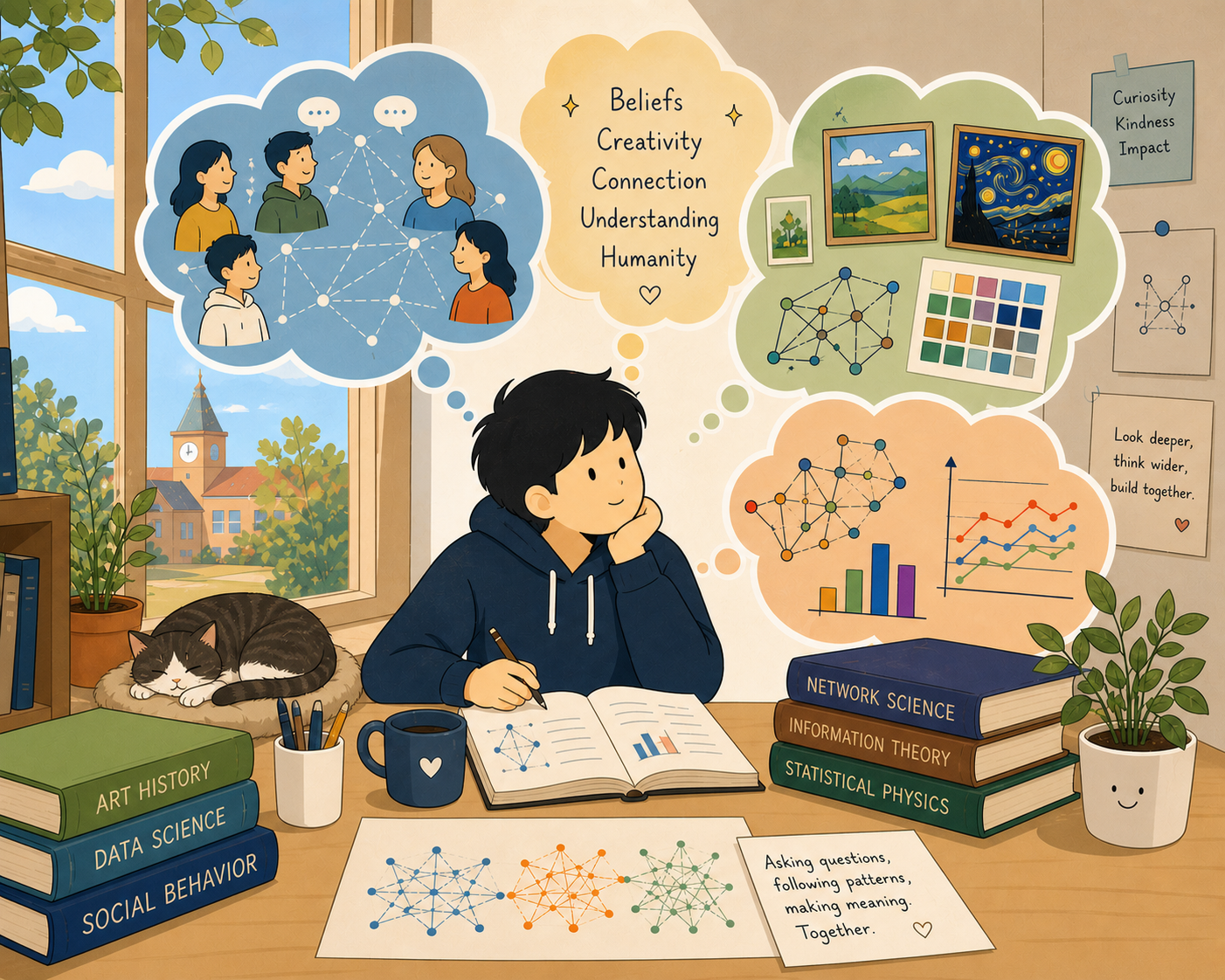
My research develops quantitative and interpretable frameworks for understanding human beliefs, behavior, and creativity. Across my work, I represent beliefs and cultural expressions as structured entities in high-dimensional spaces and study their relational and geometric properties using large-scale empirical data. By combining statistical physics, information theory, network science, and modern artificial intelligence, especially large language models and multimodal AI, and by drawing on online conversations, social interaction data, digitized artworks, and cultural artifacts as traces of human cognition and expression, I pursue a unified agenda for studying the human mind and behavior at scale.
Research Vision#
My long-term goal is to build computational frameworks for asking foundational questions about human nature, including how we believe, persuade, and create, in ways that are both scientifically rigorous and socially meaningful.
Across this agenda, I treat beliefs and creative expressions as complementary manifestations of human cognition: one capturing how meaning is internally structured and negotiated, and the other capturing how it is expressed through language, images, and other cultural forms. More broadly, I pursue a human-centered approach to data science that uses AI not merely as a predictive tool, but as a lens for understanding how human beliefs and creativity are formed and evolve.
Research Identity#
My research program is organized around two complementary pillars that together define my broader approach to computational social science and cultural data analytics. One pillar focuses on the computational understanding of human creativity and artistic expression, from long-term patterns in art history to contemporary digital creativity and multimodal generative AI. The other focuses on modeling human beliefs, persuasion, and collective social behavior using language models, embeddings, and network analysis. These two pillars are closely connected, and they are organized around the following two core questions.
Core Questions#
-
💭 How can beliefs be represented and modeled?
How can human beliefs and cognition be meaningfully represented in high-dimensional spaces, and how do beliefs evolve, interact, and change within those spaces? -
🎨 How can creativity and cultural expression be quantified?
How can creativity and cultural expression be modeled from data at scale, and how do artistic forms emerge, evolve, and become expressed across historical, social, and technological contexts?
Research Themes#
Representing Human Beliefs with AI#
I study how large language models can represent human belief systems, political judgment, and semantic variation in public discourse. This line of work connects representation learning, computational social science, and human-centered AI, while asking how latent geometry can reveal the structure, interdependence, and dynamics of beliefs at scale.
Understanding Creativity in Art at Scale#
I use information theory, multimodal learning, and cultural data to study long-term patterns in art history, stylistic change, and visual creativity. This includes work on landscape painting, user-generated art, and multimodal AI for cultural analysis, with an emphasis on how artistic forms become organized, transmitted, and transformed over time.
Analyzing Media Networks and Social Dynamics#
I examine online polarization, media ecosystems, and networked social behavior. My work in this area includes research on news press structure, discourse around epidemics, and hidden dependencies in weighted networks, with a focus on how collective patterns emerge from interaction, attention, and affective engagement.
Looking Ahead#
Moving forward, I want to deepen two connected directions: multimodal AI for studying creativity and cultural meaning, and a more general theory of belief dynamics and persuasion that integrates language, trajectories, networks, and external social events. I am especially interested in how these directions can support interpretable human-AI communication, illuminate the societal implications of large-scale social inference, and create principled tools for studying culture and behavior in real-world institutional contexts.
Selected Projects#
- A semantic embedding space based on large language models for modelling human beliefs in Nature Human Behaviour
- Dissecting landscape art history with information theory in PNAS
- Heterogeneity in chromatic distance in images and characterization of massive painting data set. in PLOSOne
- Network analysis reveals news press landscape and asymmetric user in PhysicaA
- LLMs Can Infer Political Alignment from Online Conversations in arXiv